Quick answer: Apparel sells on TikTok Shop through try-on creator content, which is the platform's highest-converting format. The two constraints are returns — every sizing ambiguity in a listing comes back as a return that eats margin — and production, because a single viral video can outsell a normal month.
At a glance
- $1.42B
- estimated US TikTok Shop sales in Womenswear & Underwear, January–July 2026, #2 on the platform
- 77.5%
- of those sales came through affiliate creators, not the brand's own account
- 40,788
- active shops competing in the category
- $48,259/mo
- a womenswear shop, up from $15,000 in 2 months
Category figures: Kalodata estimates, 1 January – 31 July 2026, from our 2026 category benchmarks. Our figure: one client account, from TikTok Shop Seller Center reporting — a selected engagement, not an average.
What we see across the apparel shops we manage
Apparel is where a single creator video most often changes the business rather than the month. A denim brand we ran had one creator video pass 500K views; monthly GMV moved from $786 to $6,609 over three months across 835,000 impressions, and the resulting demand reshaped their production planning.
At the other end, a womenswear brand already selling scaled from $15,000 to over $48,000 monthly GMV in two months at a 9.59× ROI.
Methodology: figures are from two individual client accounts we operated, taken from TikTok Shop Seller Center reporting over the periods stated. Selected engagements, not an average; past performance is not a guarantee of future results.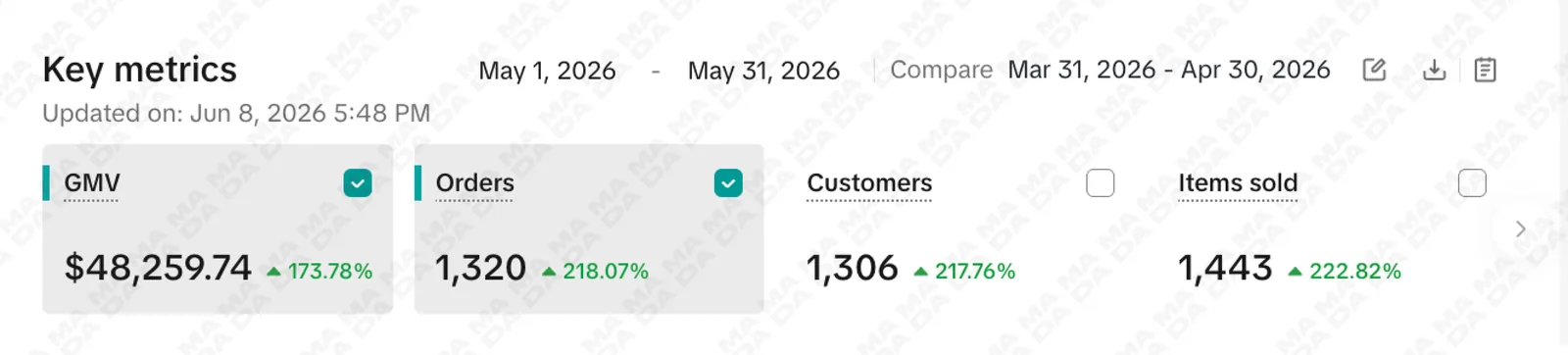
Tripled monthly GMV at 9.59× ROI in 60 days
Scaled a women's apparel brand from $15K to $48K monthly GMV in 2 months.
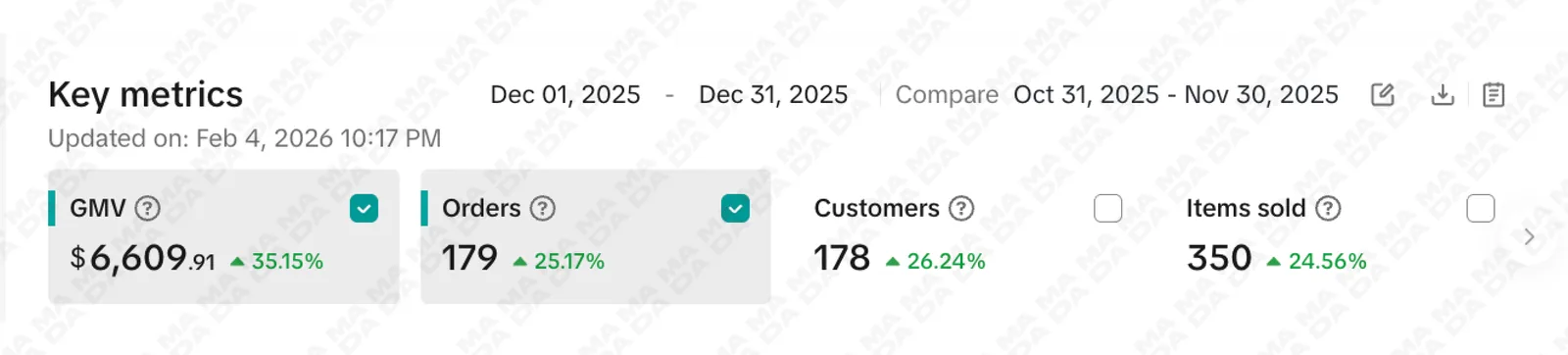
Scaled monthly GMV by 8.4× in 90 days
Grew a denim brand's monthly GMV from $786 to $6.6K in 90 days.
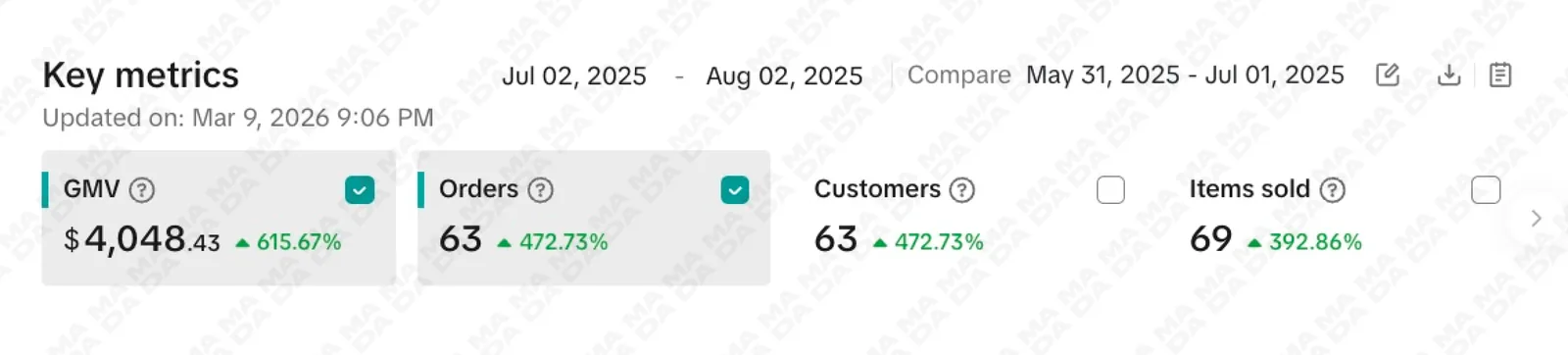
7× GMV in one month at 10.75× ROI + 400K views
Grew a shapewear brand's GMV from $566 to $4K in 30 days.
All case studies, each with the Seller Center export behind it →

Mike Dos · Founder of MADA
Get a launch plan for your apparel brand
Free 30-minute call · a diagnostic, not a pitch
Get my launch plan → Get a free shop audit A womenswear brand that tripled GMV in 60 days
On this page
What decides whether apparel sells profitably on TikTok Shop?
Three things decide whether an apparel brand's TikTok Shop sales turn into profit: the try-on content that sells the garment, the returns that follow, and whether production can keep up when a video works.
Try-on content converts
Try-on shows fit, drape and movement in a way product photography cannot, and it does so in the format the feed already rewards. Casting across genuinely different body types is what makes it credible, and credibility is what converts in apparel.
Returns decide margin
Returns are where apparel GMV growth and apparel profit growth diverge. Every ambiguity left in size guidance, variants or imagery returns as a refund, and commission on returned orders does not ultimately pay out. Tightening the listing before driving traffic is cheaper than any optimization afterwards.
Stock decides whether a viral video pays
Demand spikes are worthless if you cannot ship. Creator volume should be paced against inventory depth and lead times, and sell-through data should feed back into what gets produced next rather than being treated as a marketing metric.
How do you set commission in apparel when returns claw it back?
Against landed margin after an assumed return rate, not against headline price. Apparel is the category where the difference between those two numbers is largest, and a commission set against the wrong one turns growth into losses quietly enough that it takes a quarter to notice.
| Line | Why apparel differs |
|---|---|
| Selling price | The number most brands set commission against — and the wrong one |
| TikTok referral fee | 6% of the item price in most US categories, before anything else is deducted |
| Creator commission | Set by you; the largest variable cost in most apparel programmes |
| Landed product cost | Manufacture, freight and duty |
| Returns | The apparel-specific line. Reverse logistics plus the unit that may not be resellable |
| What is actually left | The only number commission should be set against |
The affiliate commission calculator runs this with a return rate as an input and gives the highest rate that still clears a target margin.
What does an apparel launch look like month by month?
Apparel launches are paced by production lead time more than by creator supply, which is the opposite of most categories.
| Period | What happens | What is being built |
|---|---|---|
| Weeks 1–2 | Listing build with real size charts and measurements, variant setup, shipping templates; Affiliate Center programme opened | A listing that will not generate returns |
| Weeks 2–6 | Sampling across genuinely different body types; first try-on content live | Credible fit evidence for a range of buyers |
| Month 2, from mid-month | Spark Ads on a small daily test budget behind the first try-on videos that converted organically | Evidence of which videos sell when paid |
| Weeks 6–12 | Creator volume raised against stock depth; Target Collaboration to creators who sold; sell-through feeding the next production run; in month 3, ad budget raised only on the videos that produced orders | Supply and demand moving together, and paid scale on proven creative |
The constraint on an apparel launch is almost never how many creators you can recruit. It is how many units you can ship in the week after one of them works.
How do you cast creators for fit-led apparel?
By matching body type to the buyer, not by reach. A try-on video converts because a viewer recognises their own proportions in it, which means a programme casting only one body type is showing most of its audience a garment they cannot judge. Every apparel creator brief asks for the same details, because they turn a video from aspirational content into buying information:
- Creators cast across genuinely different body types, matched to the buyer
- Height stated on camera
- Usual size stated on camera
- The garment shown moving rather than posed
A womenswear brand we ran reached $7,775 in monthly GMV inside 90 days, with the step change coming from one creator video rather than from steady accumulation.
Methodology: figure is from one client account we operated, taken from TikTok Shop Seller Center reporting over the period stated. Selected engagement, not an average; past performance is not a guarantee of future results.When is TikTok Shop wrong for an apparel brand?
When the margin cannot survive the return rate, and when production cannot survive success. Not yet if:
- Landed margin is thin and sizing is vague. The brand will grow GMV and lose money, because every sizing ambiguity comes back as a return that carries reverse-logistics cost and a unit that may not be resellable.
- Production lead times are long and there is no buffer stock. Selling out during a viral moment sounds like a success and is usually a loss.
Why a sell-out costs more than it looks
When an apparel shop sells out mid-moment, the creator effort that produced the demand is spent, the momentum does not wait, and the listing's conversion history stalls at exactly the point the algorithm was starting to favour it.
How big is apparel on US TikTok Shop?
Womenswear & Underwear is the second-largest category on US TikTok Shop: an estimated $1.42B between 1 January and 31 July 2026, 13.4% of platform revenue, across 40,788 active shops. It is also one of the most open markets on the platform.
| Womenswear & Underwear, Jan–Jul 2026 | Value |
|---|---|
| Estimated revenue | $1.42B |
| Share of all TikTok Shop revenue | 13.4% |
| Active shops | 40,788 |
| Average revenue per shop | $34.8K |
| Share held by the three largest shops | 5.1% |
| Share held by the ten largest shops | 13.3% |
| Revenue from affiliate creators | 77.5% |
| Short video / LIVE / product card | 68.8% / 14.7% / 16.5% |
The top three shops take just 5.1% of category revenue and the top ten 13.3% — the least concentrated large category on TikTok Shop. No incumbent dominates womenswear, so the room to enter is real; so is competition from forty thousand other shops.
Product cards carry 16.5% of sales here, more than beauty or health. That is the browse-and-search route, and it means listing quality — images, fit information, size charts, attributes — converts revenue that never touched a creator video.
Source: Kalodata estimates of US TikTok Shop sales, 1 January – 31 July 2026, retrieved 22 September 2026. Analysis by MADA. Full analysis: TikTok Shop US category benchmarks, January–July 2026.
Frequently asked questions
Yes — apparel is among the strongest categories because try-on content demonstrates the product natively in the format the feed rewards.
By tightening size guidance, variants and imagery before driving traffic, and by casting creators across real body types so buyers can judge fit accurately.
It costs more than it appears to. We pace creator activity against inventory and lead times so demand and supply stay aligned.
Mike DosFounder of MADAOfficial TikTok Shop Partner
Get a launch plan for your apparel brand
Tell us your product and where you are today. We tell you what TikTok Shop would take for an apparel brand — compliance, creators, stock and budget — including when the answer is that it is not worth it yet.
Get my launch plan → Get a free TikTok Shop audit A womenswear brand that tripled GMV in 60 days
Free 30-minute call · a diagnostic, not a pitch. You leave knowing whether TikTok Shop is worth it for you yet, and what it would take · 3-month terms, and you keep the shop, data and creators.
Or message us on WhatsApp, or email [email protected]